
Sub-Total: $0.00
Real Estate Investing Strategies: How to Choose the Right Approach

Real estate investing offers multiple ways to pursue income, long-term wealth building, property appreciation, and business growth. However, the right strategy depends on more than the property itself. Your available capital, financing options, experience, time commitment, risk tolerance, and financial goals all influence which approach may be appropriate.
Some investors focus on acquiring rental properties and holding them for years. Others renovate and resell homes, use the BRRRR strategy to build a rental portfolio, invest in multifamily properties, or participate in real estate through REITs and partnerships.
There is no single real estate investing strategy that works best for everyone. The goal is to understand how each approach works, evaluate its financial requirements, and choose a strategy you can analyze and execute responsibly.
This guide explains common real estate investing strategies, their potential advantages and disadvantages, and the numbers investors should review before committing capital.
What Is a Real Estate Investing Strategy?
A real estate investing strategy is a plan for acquiring, financing, operating, improving, or selling property to pursue a defined financial objective.
Your strategy determines the types of properties you target, how you finance acquisitions, how you generate income, how actively you participate, and when or how you intend to exit an investment.
For example, a buy-and-hold investor may prioritize rental cash flow, manageable maintenance costs, and long-term ownership. A house flipper may focus on acquisition discounts, renovation budgets, project timelines, and resale value.
A strategy should connect your financial goals with a repeatable process for evaluating opportunities. It should also account for risks, operating expenses, financing costs, and the possibility that actual results will differ from projections.
How to Choose the Right Real Estate Investment Strategy
Before choosing an approach, evaluate your current circumstances and what you want your investments to accomplish.
1. Determine Your Available Capital
Different strategies require different amounts of money upfront. Your budget should include more than the down payment or purchase price.
Consider acquisition costs, closing costs, inspections, financing fees, repairs, reserves, insurance, taxes, and other expenses. Renovation projects may also require funds for permits, contractors, utilities, and carrying costs while the property is not producing income.
Keep an appropriate reserve for emergencies and unexpected expenses. Investing all your available cash in one property can leave you financially exposed if repairs arise, a tenant stops paying, or a project takes longer than expected.
2. Evaluate Your Financing Options
Financing affects both the amount of capital you need and the risks you assume.
Depending on your circumstances, potential options may include conventional mortgages, investor loans, renovation financing, commercial loans, private financing, partnerships, or cash purchases.
Compare interest rates, points, fees, loan terms, required equity, repayment schedules, prepayment provisions, and refinancing conditions. Confirm eligibility and terms directly with the lender or financing provider.
Do not evaluate a property solely on whether you can obtain financing. Determine whether the investment remains financially viable after accounting for the full cost of borrowing.
3. Decide How Much Time You Can Commit
Some strategies require significant ongoing involvement. Managing tenants, coordinating repairs, overseeing renovations, finding deals, and handling vacancies can demand considerable time.
Other approaches may involve less direct operational work, although less involvement does not eliminate investment risk or the need for due diligence.
Be realistic about your schedule, experience, and willingness to manage unexpected problems. If you intend to hire a property manager or contractor, include those costs in your analysis.
4. Define Your Investment Goals
Your goals should influence which strategies you consider.

Ask yourself whether you primarily want to pursue:
- Recurring rental income
- Long-term equity growth
- Profit from property renovations and resale
- Portfolio expansion through refinancing
- Exposure to commercial real estate
- A more passive approach to real estate investing
- A combination of income and long-term appreciation
These goals can overlap, but the financial assumptions and operational requirements may differ substantially.
5. Understand Your Risk Tolerance and Exit Plan
Real estate is not a guaranteed source of income or appreciation. Property values can decline, rents can fall short of expectations, financing costs can rise, and unexpected repairs can reduce returns.
Before investing, identify the conditions under which you would hold, improve, refinance, sell, or abandon a proposed project.
Consider what would happen if renovation costs increased, a property remained vacant, interest rates changed, or the resale market weakened. A strategy is more useful when it includes a plan for unfavorable scenarios—not just an optimistic forecast.
Explore our article 20 real estate investment strategies for more real estate investing strategy options.
1. Buy-and-Hold Rental Property Investing
Buy-and-hold investing involves purchasing a property, renting it to tenants, and holding it over time. Investors commonly use this approach to pursue rental income, potential equity growth, and long-term ownership.
Properties may include single-family homes, townhomes, condominiums, duplexes, or other residential rentals.
How it works
The investor evaluates the acquisition price, expected rent, financing, operating expenses, maintenance requirements, and likely vacancy. If the property meets the investor’s criteria, the investor acquires it and operates it as a rental.
Rental income is used to cover expenses and debt service. Any remaining cash flow depends on the property’s actual performance and the investor’s financing and operating costs.
Potential advantages
- Recurring rental income when the property is occupied and performing.
- Potential long-term equity growth through loan repayment and changes in property value.
- Flexibility to improve operations, renovate, or change rental strategies when appropriate.
- The opportunity to build a portfolio over time.
Potential disadvantages
- Vacancies, nonpayment, maintenance, and capital expenditures can reduce cash flow.
- Financing creates ongoing obligations even when rental income declines.
- Landlord responsibilities can require substantial time and expertise.
- Property values and rental demand can change.
What to analyze
Estimate realistic rental income and subtract vacancy, operating expenses, maintenance, capital expenditures, management fees, and debt service.
Review net operating income (NOI), capitalization rate, cash flow, cash-on-cash return, debt service coverage ratio (DSCR), and break-even occupancy where applicable.
Do not treat gross rent or a property’s advertised cap rate as proof that it will generate an acceptable return.
Useful InvestingTE tool: Rental Property Investment Calculator
2. House Hacking
House hacking involves occupying part of a property while renting another portion or otherwise using the property to offset housing expenses.
Examples may include purchasing a duplex and living in one unit while renting the other, or renting eligible rooms in a single-family home.
How it works
The owner evaluates the property’s total housing costs, potential rental income, occupancy requirements, financing eligibility, and applicable local rules. Rental income may offset some of the owner’s expenses, but it does not automatically cover the mortgage or all operating costs.
Potential advantages
- May reduce the owner’s net housing expense.
- Can provide practical experience as a landlord.
- May help an owner begin building property equity while occupying the home.
Potential disadvantages
- The owner may share the property with tenants.
- Rental income is not guaranteed.
- Financing programs can have occupancy and eligibility requirements.
- Local rental rules, insurance, taxes, and property maintenance still apply.
What to analyze
Calculate the total monthly ownership cost and compare it with conservative estimates of rent collected. Include vacancy, repairs, utilities, insurance, and expenses attributable to the rental portion.
Confirm the financing program’s requirements and local rental regulations before relying on projected rental income.
Useful InvestingTE tool: Home Buying Investment Calculator
3. Short-Term and Mid-Term Rental Investing
Short-term rentals generally accommodate guests for brief stays, while mid-term rentals commonly serve people needing housing for longer temporary periods. The exact definitions and rules vary by location and arrangement.
Potential guests may include vacationers, traveling professionals, people relocating, or others needing temporary accommodation.
How it works
The investor acquires or prepares a property, establishes a rental offering, and generates income from bookings. Operations may include furnishing, cleaning, marketing, guest communications, maintenance, and complying with applicable lodging requirements.
Potential advantages
- Pricing and occupancy may vary by season or demand.
- Certain locations may support specialized temporary-housing demand.
- A suitable property may serve different guest segments over time.
Potential disadvantages
- Revenue may fluctuate considerably.
- Furnishing, cleaning, utilities, supplies, and platform fees can be substantial.
- Local regulations, permits, zoning, and association restrictions may limit operations.
- Active management can be demanding.
What to analyze
Estimate revenue using realistic occupancy and nightly or monthly rates. Include platform fees, cleaning, furnishing replacement, utilities, insurance, taxes, maintenance, management, and seasonal vacancies.
Compare the results with a conventional rental alternative. A higher advertised nightly rate does not necessarily produce higher net income.
Useful InvestingTE tool: Free Rental Property Deal Analysis Calculator
4. House Flipping
House flipping involves acquiring a property, improving it, and reselling it. Investors may target properties that need repairs, renovations, or other improvements.
The objective is to complete the project within budget and sell for enough to cover acquisition, financing, renovation, holding, and selling expenses while leaving an acceptable potential profit.

How it works
The investor estimates the property’s after-repair value (ARV), determines the work required, develops a renovation budget, evaluates financing, and estimates the time needed to complete and sell the project.
The investor then compares the total expected project cost with a conservative resale estimate.
Potential advantages
- A project may be completed over a relatively defined period.
- Renovations can improve functionality and market appeal.
- Investors can focus on individual projects instead of long-term rental operations.
Potential disadvantages
- Renovation overruns and hidden defects can reduce or eliminate profit.
- Delays increase financing and holding costs.
- The completed property may sell for less than expected.
- Projects require reliable contractors, sound budgeting, and disciplined execution.
What to analyze
Include acquisition price, closing costs, inspection findings, renovation expenses, permits, utilities, financing, insurance, taxes, holding costs, selling expenses, and a contingency reserve.
Estimate ARV using relevant comparable sales, adjusting for differences in location, condition, size, and features. Do not assume every renovation dollar adds an equivalent amount to resale value.
Calculate projected profit, return on invested capital, and the break-even resale price. Test the project under less favorable assumptions.
Useful InvestingTE tools:
- House Flipping Investment Calculator
- After Repair Value (ARV) Investment Calculator
- Free Renovation Budget Calculator
5. The BRRRR Strategy
BRRRR stands for Buy, Rehab, Rent, Refinance, and Repeat. It is a strategy in which an investor acquires a property, renovates it, places it into rental operation, and seeks to refinance based on the lender’s underwriting and the property’s qualifying value.
The investor may then use proceeds from refinancing toward another investment, if sufficient funds are available and the terms make financial sense.
How it works
Buy: Identify a property whose acquisition cost and condition fit the investment plan.
Rehab: Complete necessary improvements while controlling costs and timelines.
Rent: Prepare the property for occupancy and establish sustainable rental operations.
Refinance: Apply for refinancing subject to lender requirements, property valuation, income, credit, seasoning rules, and available loan terms.
Repeat: Evaluate whether available capital and the property’s performance support another acquisition.
Potential advantages
- Combines value-add renovations with rental ownership.
- May allow an investor to recycle some capital.
- Provides a repeatable framework for portfolio growth.
Potential disadvantages
- Refinancing is not guaranteed.
- The appraisal or lender’s maximum loan amount may be lower than expected.
- New debt can reduce cash flow and increase financial risk.
- Renovation overruns or weak rental performance can undermine the strategy.
What to analyze
Evaluate the full acquisition and renovation budget, holding costs, expected rental performance, refinancing assumptions, debt service, and capital remaining in the property.
Test different appraisal values, interest rates, loan-to-value limits, and operating expenses. Do not assume that refinancing will return all the original investment capital.
Useful InvestingTE tool: BRRRR Investment Calculator
6. Multifamily Real Estate Investing
Multifamily properties contain multiple residential units. They range from small properties with a few units to larger apartment communities.
Investors may pursue rental income, improved operating efficiency, property improvements, or value creation through better management.

How it works
The investor analyzes current and potential rental income, vacancy, operating expenses, maintenance, management, financing, and the property’s condition.
For larger properties, the analysis often emphasizes NOI and the relationship between income, operating costs, and market valuation.
Potential advantages
- Multiple rental units can diversify rental income within a property.
- Some expenses may be shared across units.
- Property improvements or operating changes may create opportunities to increase NOI.
Potential disadvantages
- Acquisitions can require substantial capital and more complex financing.
- Maintenance, leasing, staffing, and compliance may be more demanding.
- Concentrating multiple units in one property still exposes the investor to local market and asset-specific risks.
What to analyze
Review rent rolls, leases, collections, vacancy, operating statements, deferred maintenance, capital expenditure needs, property taxes, insurance, financing, and local rental demand.
Calculate NOI, cap rate, debt service coverage, cash flow, and potential returns under conservative assumptions. For larger transactions, review financial records and property condition with qualified professionals.
Useful InvestingTE tool: Multifamily Investment Calculator
7. Wholesaling Real Estate
Real estate wholesaling generally involves locating a potential acquisition opportunity and assigning contractual purchase rights to another buyer or completing another permitted transaction structure.
Wholesaling is not the same as buying, renovating, and reselling a property that the investor owns. The legal and financial structure of each transaction matters.
How it works
A wholesaler identifies a property, negotiates a contract or other lawful arrangement, performs due diligence, and seeks a qualified end buyer. If an assignment is permitted and completed, the wholesaler may receive an assignment fee under the contract.
Potential advantages
- May require less capital than purchasing and renovating a property outright, depending on the transaction.
- Can help investors develop skills in lead generation, negotiation, and deal analysis.
- Can build relationships with property buyers and sellers.
Potential disadvantages
- Finding willing sellers and reliable buyers can be difficult.
- Contracts, deposits, marketing, and closing deadlines create risks.
- The transaction may fail if the end buyer cannot or will not close.
- Licensing, disclosure, advertising, and consumer-protection requirements may apply.
What to analyze
Understand the contract, assignment provisions, required deposits, deadlines, buyer demand, property condition, and the end buyer’s likely economics.
Verify applicable state and local requirements with a qualified real estate attorney or regulatory authority. Do not assume that calling a transaction a wholesale deal exempts it from real estate licensing or other legal requirements.
8. Real Estate Partnerships and Syndications
Partnerships and syndications allow multiple participants to invest in a property or real estate project. Depending on the structure, some investors may contribute capital while others handle acquisitions, operations, or project management.
How it works
Investors review the sponsor or operating partner, the property, the investment structure, the financing, projected cash flows, fees, distribution terms, and exit plan.
Syndications may involve securities laws and formal offering documents. The legal structure determines the rights and obligations of each participant.
Potential advantages
- May provide access to larger projects.
- Allows investors to share capital requirements and responsibilities.
- Can offer exposure to property types that would be difficult to acquire individually.
Potential disadvantages
- Investors may have limited control over operations.
- Capital may be tied up for an extended period.
- Fees, conflicts of interest, leverage, and execution risk can affect returns.
- Distributions and projected returns are not guaranteed.
What to analyze
Review the offering documents, sponsor experience, property-level assumptions, financing, fee structure, distribution priorities, conflicts of interest, reporting, liquidity restrictions, and exit provisions.
Do not rely exclusively on advertised return targets. Seek independent legal, tax, and financial advice where appropriate, and verify the relevant parties and offering information.
9. Real Estate Investment Trusts (REITs)
A real estate investment trust, or REIT, provides a way to invest in real estate through a company that owns or finances income-producing real estate.
Publicly traded REITs can be purchased through a brokerage account. Other REIT structures may have different liquidity, valuation, fee, and redemption characteristics.
Potential advantages
- Can provide exposure to real estate without directly buying and managing property.
- Publicly traded REITs can generally be bought or sold through an exchange.
- May provide access to property sectors and portfolios that would be difficult to own individually.
Potential disadvantages
- Share prices can fluctuate.
- Investors have limited direct control over the underlying properties.
- REITs have company, market, interest-rate, and property-sector risks.
- Non-traded REITs may involve limited liquidity and significant fees.
What to analyze
Review the REIT’s property sectors, financial statements, debt, management, fees, distributions, and liquidity provisions.
Distinguish between publicly traded and non-traded REITs before investing. Review official filings and offering documents rather than relying solely on promotional material.
For background, see the SEC’s Investor.gov guide to REITs.
10. Tax Lien and Tax Deed Investing
Tax lien and tax deed investing involve properties with delinquent property taxes, but the legal rights acquired differ by jurisdiction and sale type.
A tax lien certificate generally represents a claim or lien associated with unpaid taxes. A tax deed sale may transfer ownership subject to applicable law and the sale process. Neither should be treated as a simple, guaranteed way to acquire inexpensive real estate.
Potential advantages
- Provides access to a specialized type of property-related investment.
- Can involve a defined legal process and auction procedure.
- May fit experienced investors who are prepared to research title, property condition, and applicable statutes.
Potential disadvantages
- Redemption rights and timelines vary by jurisdiction.
- The investor may not acquire ownership of the property.
- Title issues, property condition, senior claims, legal costs, and enforcement procedures can create significant risks.
- Auction requirements and payment deadlines may be strict.
What to analyze
Research the relevant county or municipality, the applicable statutes, redemption rules, title status, property condition, access, liens, auction terms, and all required payments.
Use official government auction and tax-collection resources whenever possible. Confirm the legal rights being acquired before bidding.
Further reading: 12 Tax Lien & Tax Deed Auction Websites and Learn the Tax Lien Investing Strategy.
11. Commercial Real Estate Investing
Commercial real estate can include office buildings, retail properties, industrial facilities, self-storage, hotels, and other properties used for business or specialized purposes.
Investment analysis depends on the asset type, tenant demand, lease structure, property condition, financing, and operating requirements.
Potential advantages
- May provide access to different tenant types and lease arrangements.
- Some properties have opportunities to improve income through leasing or operational changes.
- Can diversify an investor’s exposure beyond residential property.
Potential disadvantages
- Acquisitions may require more capital and specialized expertise.
- Vacancy and tenant turnover can materially affect income.
- Financing and property operations may be complex.
- Changes in business demand can affect property performance and valuation.
What to analyze
Review leases, tenant creditworthiness, rent rolls, vacancy, operating expenses, upcoming lease expirations, capital expenditures, financing terms, and comparable transactions.
Assess the property’s likely performance under different occupancy and rental assumptions. Specialized legal, environmental, engineering, and financial due diligence may be appropriate depending on the asset.
12. Creative Financing Strategies
Creative financing refers to structures that differ from a straightforward conventional mortgage or cash purchase. Depending on the transaction, examples may include seller financing, subject-to arrangements, private lending, or other negotiated structures.
These arrangements can change how capital is contributed, how payments are made, and how risk is allocated. They do not eliminate the underlying cost of purchasing or operating a property.
Potential advantages
- May create additional ways to structure a transaction.
- Can provide alternatives when conventional financing does not fit the circumstances.
- May align payment terms with the needs of the parties.
Potential disadvantages
- Contracts can be complex and may create substantial legal or financial exposure.
- Existing mortgage terms may restrict transfers or affect the lender’s rights.
- Seller financing and private loans involve default and enforcement risks.
- Misunderstanding the structure can lead to unexpected obligations.
What to analyze
Understand the purchase agreement, financing documents, payment schedule, collateral, title implications, default remedies, insurance, tax considerations, and any existing lender restrictions.
Have a qualified real estate attorney review unfamiliar arrangements before signing. Confirm that the transaction complies with applicable laws and the parties’ contractual obligations.
How to Compare Real Estate Investing Strategies
A useful comparison should include more than potential returns. Consider capital requirements, operating demands, liquidity, financing risk, complexity, and the time needed to execute the strategy.
| Strategy | Primary objective | Typical demands | Important risks |
|---|---|---|---|
| Buy-and-hold rentals | Rental income and long-term ownership | Capital, leasing, maintenance, management | Vacancy, repairs, debt service |
| House hacking | Offset housing costs while owning | Occupancy, tenant management | Rental shortfalls, financing rules |
| Short- or mid-term rentals | Income from temporary stays | Furnishing, bookings, frequent operations | Occupancy swings, regulation |
| House flipping | Renovation and resale | Acquisition, construction, project management | Cost overruns, resale uncertainty |
| BRRRR | Renovated rental ownership and potential capital recycling | Acquisition, rehab, leasing, refinancing | Appraisal and refinancing risk |
| Multifamily | Income from multiple residential units | Capital, underwriting, property operations | Vacancy, concentration, expenses |
| Wholesaling | Contract-based transaction income | Lead generation, negotiation, contracts | Buyer failure, legal compliance |
| Partnerships or syndications | Shared ownership or investment exposure | Due diligence, sponsor evaluation | Fees, limited control, illiquidity |
| REITs | Indirect real estate exposure | Securities research and portfolio decisions | Market risk, fees, liquidity differences |
| Tax lien or deed investing | Rights associated with delinquent-tax sales | Legal and property due diligence | Redemption, title, enforcement |
| Commercial real estate | Income or value creation from commercial assets | Specialized underwriting and operations | Tenant concentration, vacancy, financing |
| Creative financing | Alternative transaction structure | Legal and financing analysis | Contractual obligations, default |
The capital and time demands in this table are general descriptions, not fixed requirements. Actual requirements vary widely by property, market, transaction, and investor.
How to Analyze a Real Estate Investment Before You Buy
Regardless of the strategy, use a consistent financial review before committing capital.
Analyze Your Next Real Estate Investment
Choosing a strategy is only the beginning. Before committing capital, evaluate acquisition costs, financing, operating expenses, renovation assumptions, and potential returns.
InvestingTE offers Excel-based calculators designed for rental properties, house flipping, BRRRR, multifamily investing, property valuation, and renovation budgeting.
Explore Real Estate Investment Calculators
Choose a tool that matches your strategy, organize your assumptions, and compare scenarios before making an investment decision.
Estimate acquisition and upfront costs
Include the purchase price, closing costs, inspections, financing fees, initial repairs, renovation costs, and any required reserves.
Estimate realistic income
Use market-supported rents, occupancy assumptions, or resale estimates. Avoid relying solely on seller claims, optimistic projections, or advertised returns.
Calculate operating expenses
Consider taxes, insurance, maintenance, capital expenditures, utilities, management, vacancy, and other costs relevant to the property and strategy.
Review financing
Understand the interest rate, loan term, repayment obligations, fees, and potential refinancing conditions. Test whether the investment remains viable if financing costs or available proceeds differ from expectations.
Calculate the metrics that fit your strategy
Depending on the investment, useful metrics may include:
- Net operating income (NOI)
- Capitalization rate (cap rate)
- Cash flow
- Cash-on-cash return
- Debt service coverage ratio (DSCR)
- Break-even occupancy
- Total project cost
- Projected profit and return on invested capital
- After-repair value (ARV)
- Equity and refinancing assumptions
These metrics answer different questions. A cap rate, for example, does not account for an investor’s particular financing in the same way that a cash-on-cash return calculation does.
Test unfavorable scenarios
Estimate how the investment would perform if income declined, expenses increased, repairs exceeded expectations, or a sale or refinance took longer than planned.
A deal that works only under optimistic assumptions may not offer an acceptable margin of safety.
Document your assumptions
Keep a written record of the information used in your analysis, the source of each estimate, unresolved questions, and the conditions that would cause you to reject the opportunity.
Choose Tools That Match Your Investment Strategy
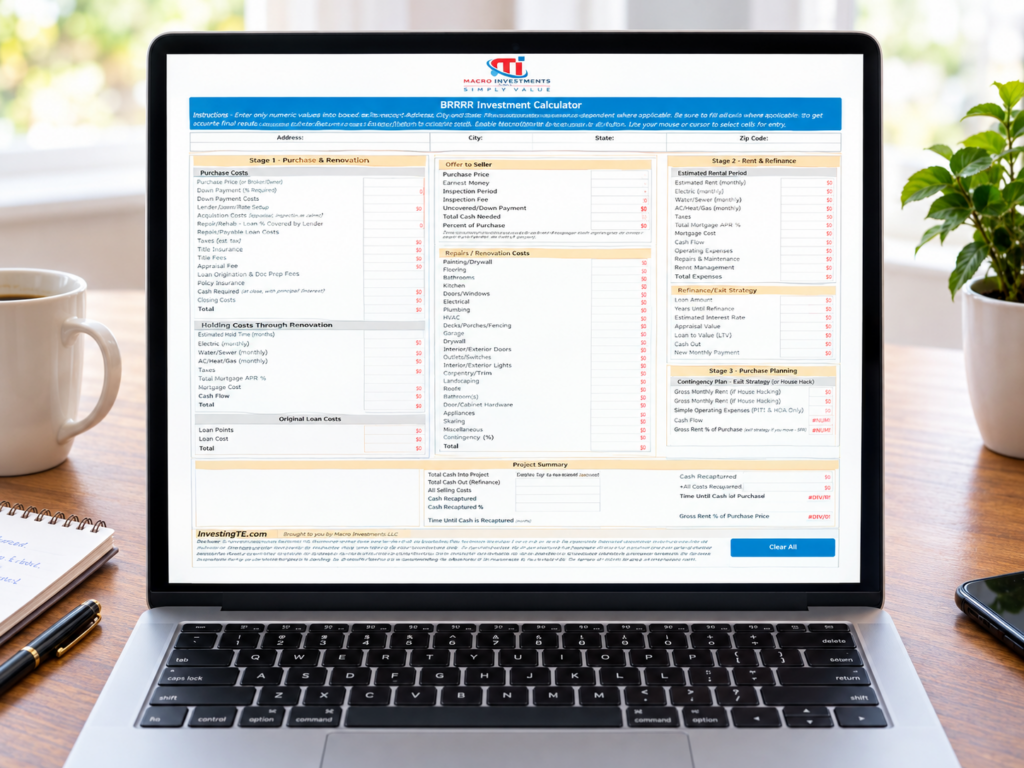
Different strategies require different calculations. A rental property analysis is not the same as a house-flipping budget, a BRRRR refinance model, or a multifamily acquisition analysis.
InvestingTE provides Excel-based tools designed to help investors organize assumptions and evaluate potential scenarios.
- Rental properties: Rental Property Investment Calculator
- House flipping: House Flipping Investment Calculator
- BRRRR: BRRRR Investment Calculator
- Multifamily: Multifamily Investment Calculator
- Property valuation: After Repair Value Calculator
- Renovation budgeting: Free Renovation Budget Calculator
- Rental deal screening: Free Rental Property Deal Analysis Calculator
You can also explore all InvestingTE investment calculators and tools to find tools suited to your next analysis.
The purpose of a calculator is to organize assumptions, apply formulas consistently, and compare scenarios. Its output is only as useful as the information entered and does not guarantee a particular investment outcome.
Frequently Asked Questions About Real Estate Investing Strategies
Which real estate investing strategy is best for beginners?
There is no universally best strategy for beginners. The appropriate starting point depends on available capital, financing, time, experience, and risk tolerance. Start by learning the requirements and analyzing realistic scenarios before committing money.
Which real estate strategy requires the least capital?
Capital requirements vary significantly. Indirect investments such as publicly traded REITs may offer real estate exposure without purchasing an entire property. Direct strategies may require down payments, closing costs, reserves, or project capital. Review the costs and risks of each structure rather than assuming one is automatically inexpensive.
Is buy-and-hold investing better than house flipping?
They serve different objectives. Buy-and-hold focuses on operating a property over time, while flipping depends on acquiring, improving, and reselling a property within an acceptable budget and timeline. Compare the capital requirements, time commitment, risk, and expected results of each approach.
What is the BRRRR strategy?
BRRRR stands for Buy, Rehab, Rent, Refinance, and Repeat. It combines acquisition, renovation, rental operation, and potential refinancing. The ability to refinance and recover capital depends on property value, lender requirements, financing terms, and the property’s performance.
Can real estate investing generate passive income?
Some approaches require less day-to-day involvement than others, but no real estate investment is entirely free of risk or oversight. Direct ownership can involve management, repairs, vacancies, and financing obligations. Indirect investments may reduce operational responsibilities but have their own market, fee, and liquidity risks.
How do I evaluate whether a real estate investment is profitable?
Start with realistic income, acquisition costs, operating expenses, financing, maintenance, capital expenditures, and potential exit costs. Then calculate the metrics appropriate to the strategy and test unfavorable scenarios. Projected returns should be treated as estimates, not guarantees.
Should I use a real estate investment calculator?
A calculator can help you organize assumptions, apply formulas, and compare scenarios consistently. Choose one designed for the strategy you are evaluating, verify the inputs, and confirm important assumptions with qualified professionals where necessary.
Final Thoughts: Build a Repeatable Investment Process
Choosing a real estate investing strategy begins with understanding your goals, capital, time, experience, and tolerance for risk. The next step is to evaluate opportunities using realistic assumptions and a consistent financial process.
Whether you pursue rental properties, house flipping, BRRRR, multifamily investing, or another approach, focus on understanding the costs, obligations, and potential downside before committing capital.
Use reliable data, perform appropriate due diligence, and compare multiple scenarios. A disciplined process cannot eliminate investment risk, but it can help you make better-informed decisions.
Ready to analyze your next opportunity? Explore InvestingTE’s real estate investment calculators and tools to find an analysis tool suited to your strategy.
Analyze Your Next Real Estate Investment
Choosing a strategy is only the beginning. Before committing capital, evaluate acquisition costs, financing, operating expenses, renovation assumptions, and potential returns.
InvestingTE offers Excel-based calculators designed for rental properties, house flipping, BRRRR, multifamily investing, property valuation, and renovation budgeting.
Explore Real Estate Investment Calculators
Choose a tool that matches your strategy, organize your assumptions, and compare scenarios before making an investment decision.
Disclaimer: This article is for educational purposes only and does not constitute financial, investment, tax, legal, lending, or accounting advice. Real estate investments involve risk, including potential loss of capital. Results depend on property-specific conditions, financing, market circumstances, and the accuracy of assumptions. Consult appropriately qualified professionals regarding your circumstances.
FREE Deal Analysis for Rental Property Calculator!
Our mission is to help others develop using our tools and educational information.
Explore our tools, education and services.