
Sub-Total: $0.00
Personal Financial Planning Made Easy: Budget, Save, and Invest

Personal financial planning doesn’t have to be complicated. Whether you’re trying to control monthly spending, pay down debt, build savings, or prepare for future investments, a clear plan can help you make more informed decisions about your money.
The first step is understanding where your money comes from, where it goes, and what you want it to accomplish.
A personal financial plan brings those pieces together. It can help you organize income and expenses, establish savings goals, manage debt, prepare for unexpected costs, and evaluate how your current habits may affect your future finances.
In this guide, you’ll learn how to build a practical budget, use the 50/30/20 budgeting rule as a starting point, set financial goals, and use InvestingTE’s free interactive Financial Planning Calculator to explore different scenarios.
What Is Personal Financial Planning?
Personal financial planning is the process of organizing your finances around your current needs and future goals.
A financial plan may include:
- Income and monthly expenses
- Essential bills and discretionary spending
- Debt balances and repayment plans
- Emergency savings
- Short- and long-term savings goals
- Retirement and investment planning
- Insurance and other financial protections
- Periodic reviews as your circumstances change
A budget is one part of this process. It helps you understand how much money is coming in, how much is going out, and how much may be available for savings or other priorities.
A broader financial plan also considers how today’s decisions affect your future options.
For example, reducing a recurring expense could free up money for an emergency fund. Paying down high-interest debt may reduce interest costs. Increasing regular savings may help you prepare for a major purchase or long-term goal.
The best plan is one that reflects your actual circumstances and that you can review and maintain over time.
Step 1: Understand Your Income and Expenses

Before deciding how much to save or invest, establish a realistic picture of your current finances.
Calculate your income
Start with the money you can reasonably expect to receive. If you’re paid a salary, review your take-home pay after taxes and payroll deductions. If you earn commissions, freelance income, or seasonal income, use a conservative estimate based on your actual history.
For budgeting, take-home income is often the most practical starting point because it reflects the money available for household expenses and financial goals.
If your income varies, consider using a conservative monthly baseline and planning separately for unusually strong or weak months.
List your expenses
Review bank statements, credit card statements, bills, and receipts. Categorize expenses so you can identify patterns rather than relying on memory.
Common categories include:
- Housing and utilities
- Groceries and household supplies
- Transportation
- Insurance and medical costs
- Minimum debt payments
- Childcare and family expenses
- Dining out and entertainment
- Subscriptions and memberships
- Savings and investments
- Irregular or annual expenses
Include expenses that don’t occur every month, such as vehicle maintenance, insurance renewals, property taxes, school expenses, and holiday spending.
One way to plan for these costs is to estimate the annual amount and divide it by 12. That gives you a monthly target to set aside, although the actual timing of payments still matters.
Calculate what remains
Subtract your estimated monthly expenses from your take-home income.
If the result is positive, decide how much should go toward emergency savings, debt repayment, planned purchases, and long-term goals.
If expenses exceed income, identify the largest categories that can realistically change. You may need to adjust discretionary spending, review recurring bills, explore ways to increase income, or revisit your current obligations.
The objective is not to create a perfect budget on the first attempt. It is to establish an accurate baseline that you can improve.
Step 2: Use the 50/30/20 Budgeting Rule
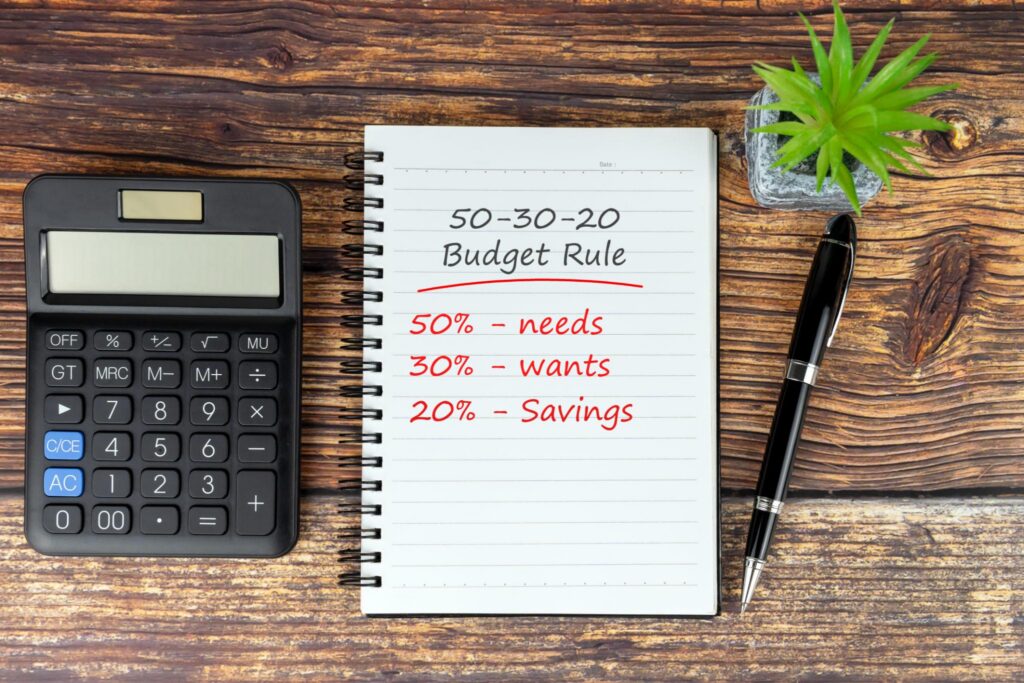
The 50/30/20 rule is a simple framework for organizing take-home income into three broad categories:
- 50% for needs: Essential expenses such as housing, basic utilities, groceries, necessary transportation, and required payments.
- 30% for wants: Discretionary expenses such as entertainment, dining out, hobbies, and optional purchases.
- 20% for savings and financial priorities: Savings, investments, and additional debt repayment, depending on how you define and organize your plan.
These percentages are guidelines, not universal requirements. Housing costs, income, debt, family size, and location may make the suggested allocation unrealistic for some households.
Example: A $4,000 monthly take-home income
Suppose your household receives $4,000 per month after taxes and payroll deductions.
| Budget category | Target percentage | Monthly amount |
|---|---|---|
| Needs | 50% | $2,000 |
| Wants | 30% | $1,200 |
| Savings and financial priorities | 20% | $800 |
| Total | 100% | $4,000 |
This is an illustrative example, not a recommended allocation for every household.
If essential expenses already total $2,700, forcing them into a $2,000 limit may not be realistic. Instead, use the framework to understand your current allocation, identify opportunities to adjust spending, and set a practical improvement target.
For example, you might initially aim to reduce discretionary spending by $100 per month and direct that money toward savings or a debt balance.
Small, sustainable changes can be more useful than a budget that looks good on paper but is impossible to follow.
Step 3: Set Clear Financial Goals
A budget becomes more meaningful when you know what you are working toward.
Your goals might include:
- Building an emergency fund
- Paying off credit card debt
- Saving for a home purchase
- Preparing for education expenses
- Increasing retirement contributions
- Funding a renovation or major purchase
- Building capital for a future investment
Make each goal as specific as possible. Estimate the amount needed, the target date, and how much you can realistically contribute.
For example, if you want to save $2,400 over 12 months, you would need to set aside approximately $200 per month, before accounting for any interest earned.
If that amount does not fit your current budget, adjust the timeline or target and review the other options available to you.
Separate short-term goals from long-term investment goals. Money needed soon generally requires different considerations from money that can remain invested for many years.
Your goals, time horizon, and tolerance for investment losses all matter when deciding how to allocate investment assets.
Step 4: Build Savings and Prepare for Unexpected Expenses
Unexpected expenses can disrupt even a well-organized budget. A vehicle repair, medical bill, job interruption, or urgent home repair may require money that was not included in the usual monthly plan.
An emergency fund can help you manage these events without relying entirely on credit cards or other borrowing.
Start with a realistic target
The appropriate amount depends on your household expenses, income stability, dependents, insurance coverage, and other circumstances.
If saving a large amount feels overwhelming, establish a smaller initial target and build from there. Consistency matters more than choosing a target you cannot realistically reach.
Keep emergency savings accessible and consider the risks and protections associated with the account you choose.
Plan for predictable irregular costs
Not every unexpected-looking expense is truly unpredictable. Annual insurance premiums, vehicle registration, routine maintenance, and holiday spending can often be anticipated.
Create a separate category for these costs and set aside money regularly. This can reduce the chance that an ordinary annual bill disrupts your monthly budget.
Step 5: Include Debt in Your Financial Plan
Debt payments affect how much money is available for savings, investing, and everyday spending.
List each debt balance, interest rate, minimum payment, and due date. Include credit cards, personal loans, vehicle loans, student loans, and other relevant obligations.
Then decide on a repayment approach that fits your situation.
Consider the interest rate
High-interest debt can be expensive to carry. Paying more than the minimum may reduce the amount of interest paid over time, depending on the balance, rate, fees, and repayment schedule.
Two common approaches are:
- Debt avalanche: Direct extra payments toward the debt with the highest interest rate while maintaining required payments on other debts.
- Debt snowball: Direct extra payments toward the smallest balance first, which may help some people maintain motivation as balances are eliminated.
Both approaches can be useful. The appropriate choice depends on your financial circumstances and what helps you follow through.
Continue to account for essential expenses and reasonable emergency reserves while building your repayment plan. If your debt obligations are difficult to manage, consider qualified nonprofit credit counseling or another reputable source of assistance.
Step 6: Use a Financial Planning Calculator

Once you understand your income, expenses, savings, and debts, a calculator can help you organize the information and explore possible scenarios.
InvestingTE offers a free interactive Financial Planning Calculator designed to help users examine their budgets and financial assumptions in one place. Depending on the fields and features used, you can explore:
- Income and expense allocations
- The 50/30/20 budgeting framework
- Debt and loan payments
- Savings contributions
- Investment assumptions
- Projected future values and net worth estimates
The purpose is to help you see how different assumptions affect your plan.
For example, you might compare what happens if you reduce monthly discretionary spending, increase savings contributions, or change the amount you direct toward a debt balance.
Try the free interactive Financial Planning Calculator.
Enter realistic numbers, review the results, and adjust the assumptions to compare scenarios. If the calculator offers projections, remember that they depend on the information and assumptions you enter. They are estimates, not guarantees of future performance.
A calculator can support your decision-making, but it cannot determine every aspect of your financial situation or replace qualified professional advice when you need it.
Step 7: Review Your Investments and Future Plans
Financial planning extends beyond the monthly budget once you have established a working process for managing income, expenses, debt, and savings.
If you invest, consider the purpose of each investment, when you expect to need the money, and how much risk you can tolerate.
Match investments to your goals
Money intended for a short-term expense generally calls for different considerations from money being invested for a long-term goal.
The appropriate mix of investments depends on your time horizon, financial circumstances, and willingness and ability to accept losses.
Diversification—spreading investments across different assets and holdings—can help manage some investment risks, but it cannot eliminate the possibility of losses.
Use projections carefully
Financial projections can help you explore how different contribution amounts, timelines, or assumed returns may affect a future balance.
However, actual investment returns vary. Fees, taxes, inflation, market changes, and other factors can affect real-world outcomes.
Avoid treating a projection as a promise or assuming that a higher assumed return is necessarily a better plan.
Include all relevant assets and liabilities
A broader view of your finances may include savings, retirement accounts, investment accounts, real estate, loans, and other significant assets or obligations.
Net worth is generally calculated by subtracting total liabilities from total assets. Tracking it periodically can help you understand how your overall financial position changes, but it should be considered alongside cash flow, liquidity, and progress toward your goals.
Step 8: Review and Adjust Your Plan

A financial plan should change when your circumstances change.
Review your budget periodically and revisit it after major events, such as a new job, change in income, move, marriage, new child, significant purchase, or change in financial goals.
Ask yourself:
- Did actual spending match the plan?
- Were irregular expenses included accurately?
- Did savings contributions happen as expected?
- Are debt balances moving in the intended direction?
- Have my goals or timelines changed?
- Do my investment assumptions still make sense?
Use the answers to make realistic adjustments. A budget is not a test you pass or fail; it is a tool for making decisions with better information.
Frequently Asked Questions About Personal Financial Planning
What is the first step in personal financial planning?
Start by understanding your take-home income, recurring expenses, debts, savings, and upcoming obligations. That gives you a baseline from which to establish realistic goals and make changes.
What is the 50/30/20 rule?
It is a budgeting framework that allocates 50% of take-home income to needs, 30% to wants, and 20% to savings and financial priorities. It is a guideline rather than a requirement, and the percentages may need to be adjusted for your circumstances.
How much should I save each month?
There is no single amount that fits every household. Consider your income, essential expenses, debts, emergency reserves, and goals. Choose a contribution you can maintain and increase it when your circumstances allow.
Should I pay off debt or save money first?
The answer depends on your debt interest rates, cash reserves, essential expenses, and financial risks. Many people work toward a starter emergency fund while making required debt payments, then balance additional savings with accelerated repayment of expensive debt. Your own situation may require a different approach.
What does a financial planning calculator do?
A financial planning calculator helps organize financial information and evaluate assumptions. Depending on its features, it may estimate budget allocations, debt payoff, savings accumulation, or future investment values. Results depend on the accuracy of the inputs and assumptions.
Is the 50/30/20 rule right for everyone?
No. It is a useful starting point, but high housing costs, irregular income, family obligations, or significant debt may require a different allocation. Use it to understand your spending rather than forcing your finances into fixed percentages.
Build Your Financial Plan With a Free Calculator
Organize your income, expenses, debt, savings, and investment assumptions in one place. Use InvestingTE’s free interactive Financial Planning Calculator to explore your budget and compare potential financial scenarios.
Try the Free Financial Planning Calculator
References: Consumer Financial Protection Bureau — Why financial well-being?. Useful for framing financial well-being around day-to-day control, resilience to financial shocks, and progress toward goals.
Investor.gov — Invest for Your Goals. Supports the importance of defining goals, assessing risk tolerance, and considering how much you can afford to invest.
Investor.gov — Asset Allocation and Diversification. Use this when explaining time horizon, risk tolerance, and diversification.
FREE Deal Analysis for Rental Property Calculator!
Our mission is to help others develop using our tools and educational information.
Explore our tools, education and services.