
Sub-Total: $0.00
What Is a Good Cap Rate for a Rental Property?

A good capitalization rate, or cap rate, for a rental property depends on the local market, property type, operating expenses, property condition, and investment risk. There is no single percentage that automatically makes a rental property a good investment.
A higher cap rate may indicate stronger income relative to property value, but it can also reflect higher operating expenses, deferred maintenance, vacancy risk, or other challenges. A lower cap rate may be associated with a property in a market where investors are willing to accept a lower income yield, but that does not guarantee the property will appreciate or perform well.
The best way to evaluate a rental property cap rate is to compare it with similar properties, calculate net operating income accurately, and review the property’s cash flow, capital expenditure needs, and financing assumptions.
In this guide, you’ll learn how cap rate works, how to calculate it, how to compare properties, and how to use it as part of a complete rental property investment analysis.
What Is Cap Rate in Real Estate?
Capitalization rate is a metric that expresses a property’s annual net operating income (NOI) as a percentage of its value or purchase price.
Investors use cap rate to evaluate the relationship between a property’s operating income and the amount paid for the property, before considering the effects of financing.
Cap Rate Formula
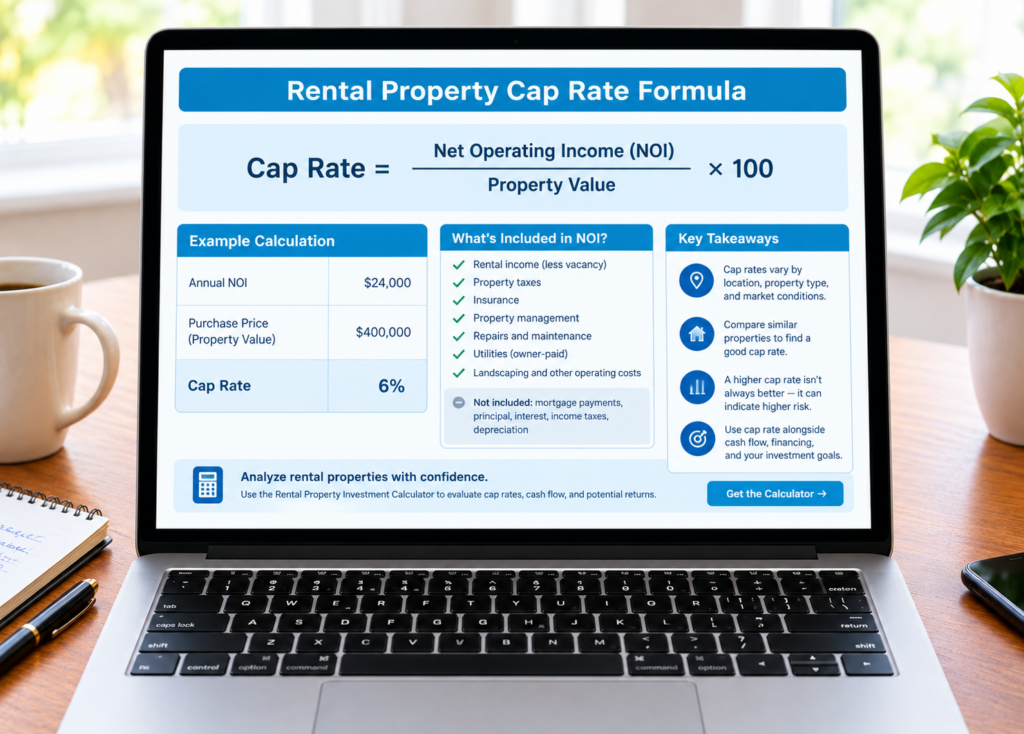
Cap Rate = Annual Net Operating Income ÷ Property Value × 100
For an acquisition analysis, investors commonly use the purchase price as the property-value denominator. When evaluating an existing asset, market value may be used instead, depending on the purpose of the analysis.
Example: Calculating a Rental Property Cap Rate
Suppose a rental property has:
- Annual net operating income: $24,000
- Purchase price: $400,000
The calculation is:
$24,000 ÷ $400,000 × 100 = 6% cap rate
Under these assumptions, the property generates annual NOI equal to 6% of its purchase price.
This does not mean the investor earns a 6% cash-on-cash return. Cap rate is calculated before mortgage payments and does not measure the return on the investor’s actual cash contribution.
How to Calculate Net Operating Income (NOI)
A reliable cap rate calculation begins with an accurate estimate of net operating income.
NOI = Effective Rental Income − Operating Expenses
Start with the property’s expected rental income, then account for vacancy and other applicable income adjustments. Subtract the expenses required to operate and maintain the property.
Operating expenses commonly include:
- Property taxes
- Landlord insurance
- Property management
- Routine maintenance and repairs
- Utilities paid by the owner
- Landscaping and snow removal
- Owner-paid water, sewer, and trash
- Advertising and leasing-related operating costs
- Other recurring property operating expenses
Depending on the property’s operations, other recurring costs may also need to be included.
Mortgage principal and interest are excluded from NOI because cap rate is intended to measure the property’s operating performance before financing. Income taxes and depreciation are also generally excluded.
Capital expenditures, such as a major roof replacement or HVAC replacement, require careful treatment. They may not appear as ordinary operating expenses in a standard NOI calculation, but investors should still evaluate their expected cost when determining the property’s long-term financial attractiveness.
Example: Calculating NOI
Assume a rental property generates $36,000 in annual scheduled rent.
| Income and expense item | Annual amount |
|---|---|
| Scheduled rental income | $36,000 |
| Vacancy allowance | −$1,800 |
| Effective rental income | $34,200 |
| Property taxes | −$4,000 |
| Insurance | −$1,500 |
| Property management | −$3,420 |
| Repairs and routine maintenance | −$2,000 |
| Owner-paid utilities and other operating expenses | −$1,280 |
| Estimated annual NOI | $22,000 |
These figures are hypothetical and illustrate the calculation rather than representing current expenses for a particular property.
If the purchase price is $275,000, the cap rate is:
$22,000 ÷ $275,000 × 100 = 8% cap rate
The result depends on the income and expense assumptions. If actual taxes, insurance, maintenance, vacancy, or management costs are higher, the property’s NOI and cap rate will be lower.
What Is Considered a Good Cap Rate for a Rental Property?
A good cap rate is one that compares favorably with appropriate properties in the same market and compensates the investor for the property’s operating risks and investment requirements.
Rather than applying a universal percentage, evaluate the cap rate in context.
1. Compare properties in the same market
Cap rates can vary between cities, neighborhoods, and even property types within the same area. Differences in property values, rental demand, expenses, condition, and investor demand can influence the income yield investors accept.
Compare properties in the same local market whenever possible. If you need to compare different markets, investigate why the cap rates differ instead of assuming the higher figure is automatically better.
2. Compare similar property types
A single-family rental, small multifamily property, and larger apartment building may have different operating structures, tenant turnover, maintenance requirements, and management needs.
For a meaningful comparison, use properties with similar characteristics, such as:
- Property type and unit count
- Location and neighborhood characteristics
- Age, condition, and quality
- Rental income and tenant profile
- Operating expense structure
- Occupancy and lease characteristics
- Major repair or capital expenditure requirements
A cap rate from a different property type may provide context, but it should not be treated as a direct benchmark without accounting for those differences.
Further Reading: How to Analyze a Rental Property.
3. Evaluate the property’s condition and risks
A property with deferred maintenance may appear attractive because its purchase price is relatively low compared with its current income. However, upcoming roof, plumbing, electrical, structural, or HVAC work can materially affect the investment.
Before relying on the cap rate, determine whether the operating numbers reflect the property’s actual condition and whether future capital expenditures need to be budgeted.
4. Consider income reliability
Two properties can have similar cap rates but different levels of income stability.
Evaluate vacancy, tenant payment history, lease terms, local rental demand, upcoming lease renewals, and the property’s ability to maintain competitive rents. Consider whether the projected income is supported by current market evidence rather than optimistic assumptions.
5. Determine whether the return fits your investment strategy
Investors have different objectives. Some prioritize predictable income and limited operational complexity; others focus on value-add opportunities, increasing NOI, or repositioning a property.
The appropriate cap rate depends partly on those objectives, but the decision should also account for acquisition price, expected cash flow, capital expenditures, financing, and the risks involved.
The takeaway: A good cap rate is not simply the highest number available. It is a defensible income yield for a property whose market, operating assumptions, condition, and risks you understand.
How to Compare Cap Rates Between Rental Properties
Use a consistent process when evaluating multiple opportunities.
- Verify the income. Review leases, rent collections, vacancy, and realistic market rents.
- Normalize operating expenses. Include recurring owner-paid costs and avoid relying solely on a seller’s expense summary.
- Calculate NOI consistently. Apply the same income and expense definitions to each property.
- Use a consistent valuation basis. When comparing acquisition opportunities, calculate cap rates using purchase prices or clearly stated valuation assumptions.
- Investigate differences. Look into property condition, upcoming capital expenditures, location, and income reliability.
- Evaluate the complete investment. Compare cash flow after debt service, capital needs, and the amount of cash required to acquire and operate the property.
Whenever possible, validate assumptions using actual property records, available lease information, reliable comparable sales, and local market data. Asking rents and advertised investment returns are not substitutes for verifying actual income and expenses.
Cap Rate vs. Cash-on-Cash Return
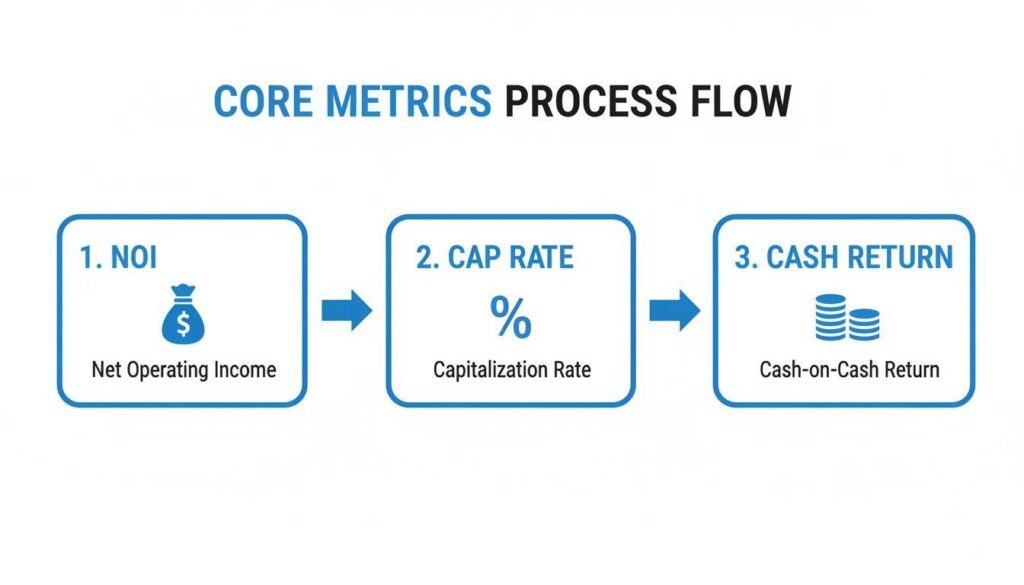
Cap rate and cash-on-cash return are both useful metrics, but they answer different questions.
| Metric | What it measures | Main consideration |
|---|---|---|
| Cap rate | NOI relative to property value or purchase price | Property operating performance before financing |
| Cash-on-cash return | Annual pre-tax cash flow relative to cash invested | The return on the investor’s actual cash contribution |
| Cash flow | Income remaining after expenses and debt service | The amount of money the property generates under the assumptions used |
Cash-on-Cash Return Formula
Cash-on-Cash Return = Annual Pre-Tax Cash Flow ÷ Total Cash Invested × 100
The Cash-on-cash return accounts for financing through the cash-flow calculation and the cash invested in the deal. Cap rate does not directly reflect either the mortgage payment or the investor’s down payment.
A property can have an attractive cap rate but a weak cash-on-cash return if financing costs are high, the down payment is substantial, or capital needs reduce the available cash flow.
Likewise, a property with a lower cap rate may still meet an investor’s objectives under a different acquisition price, financing structure, or operating plan. The full analysis matters more than any one metric.
Further Reading: How to Calculate Rental Property Cash Flow.
Common Cap Rate Mistakes

Avoid these mistakes when analyzing a rental property:
- Using gross rent instead of NOI. Cap rate is based on net operating income, not total scheduled rent.
- Including mortgage payments in NOI. Debt service belongs in the financing and cash-flow analysis, not the standard NOI calculation.
- Comparing unrelated properties. Property type, market, condition, and expenses can make direct comparisons misleading.
- Ignoring capital expenditures. Major repairs and replacements can reduce the investment’s long-term attractiveness even when current NOI looks strong.
- Using unrealistic rent assumptions. Verify expected rents and account for vacancy and other income adjustments.
- Assuming a higher cap rate always means a better deal. A higher rate can reflect risks, costs, or property characteristics that require additional investigation.
- Evaluating cap rate in isolation. Consider cash flow, financing, capital needs, acquisition price, and your investment criteria.
Rental Property Cap Rate Checklist
Before making an investment decision, confirm that you have:
- Verified current and expected rental income.
- Accounted for vacancy and other relevant income adjustments.
- Included recurring operating expenses.
- Calculated NOI using a consistent methodology.
- Compared the property with relevant local investments.
- Evaluated property condition and upcoming capital expenditures.
- Considered financing and cash-on-cash return separately.
- Tested how lower income or higher expenses would affect the result.
- Confirmed that the purchase price meets your investment criteria.
Explore our real estate investment calculators.
Analyze the Numbers Behind Your Next Rental Property
Cap rate is a useful starting point, but it is only one part of rental property analysis. A well-informed decision also considers operating expenses, capital expenditures, financing, cash flow, and the amount of cash required to acquire and operate the property.
InvestingTE’s Rental Property Investment Calculator helps you organize property assumptions and evaluate potential rental property performance.
Get the Rental Property Investment Calculator
Use the calculator to structure your analysis, compare scenarios, and review the numbers behind a potential acquisition before committing capital.
Disclaimer: This article is for educational and informational purposes only and does not constitute financial, investment, tax, legal, or accounting advice. Cap rates, income projections, and operating expenses are estimates that depend on market conditions and property-specific assumptions. Conduct appropriate due diligence and consult qualified professionals before making investment decisions.
Frequently Asked Questions
What is a good cap rate for a rental property?
A good cap rate depends on the property’s market, type, condition, operating expenses, and risk. Compare the property with similar local investments and evaluate NOI alongside cash flow, financing, and capital expenditure needs rather than relying on a universal target.
Is a higher cap rate always better?
No. A higher cap rate can indicate greater income relative to price, but it can also reflect higher expenses, property condition issues, vacancy, or other risks. Investigate why the rate is higher before deciding whether the property is attractive.
Does cap rate include the mortgage payment?
No. Standard cap rate uses net operating income before debt service. Mortgage payments are considered separately when evaluating cash flow and cash-on-cash return.
What expenses should be included when calculating NOI?
Typically, NOI accounts for effective rental income minus recurring operating expenses such as property taxes, insurance, routine maintenance, management, and owner-paid utilities. Mortgage payments are excluded. Major capital expenditures should also be evaluated separately when analyzing long-term investment performance.
Can I use cap rate to compare single-family and multifamily properties?
You can use it as one comparison metric, but differences in operating structure, expenses, tenant turnover, property condition, and risk must be considered. Compare like with like wherever possible.
FREE Deal Analysis for Rental Property Calculator!
Our mission is to help others develop using our tools and educational information.
Explore our tools, education and services.