
Sub-Total: $0.00
How to Analyze a Fix and Flip: A Complete Investment Analysis
Learning how to analyze a fix and flip is about much more than estimating a property’s resale value and subtracting the purchase price and renovation costs.
A successful investment analysis should account for the entire project, including the acquisition, after repair value (ARV), renovation budget, financing, holding expenses, selling costs, and projected profit.
The goal is to determine whether the numbers support the investment before you purchase the property or commit significant capital.
Even a property purchased below market value can become an unprofitable project if renovation costs increase, the project takes longer than expected, or the eventual resale price is lower than anticipated.
This guide explains how to analyze a fix and flip investment, calculate the major expenses, evaluate potential returns, and identify risks before moving forward.
What Is a Fix and Flip?
A fix and flip is a real estate investment strategy in which an investor purchases a property, completes renovations or improvements, and resells it with the objective of generating a profit.
The process generally involves five major stages:
- Evaluate the property’s current condition and acquisition cost.
- Estimate its potential after repair value.
- Develop a realistic renovation budget.
- Calculate financing, holding, and transaction expenses.
- Determine projected sale proceeds, profit, and investment returns.
Each stage affects the financial outcome. An error in even one major assumption can materially change the profitability of the project.
Step 1: Determine the Purchase Price
The purchase price is one of the most important inputs in a fix and flip analysis. However, a low purchase price does not automatically make a property a good investment.
The acquisition price should be evaluated in relation to the property’s condition, comparable sales, renovation requirements, expected resale value, and total project expenses.
Before making an offer, consider:
- Current market value and property condition.
- Recent comparable sales.
- Estimated renovation costs.
- Potential after repair value (ARV).
- Financing and acquisition costs.
- Expected project timeline.
- Selling expenses.
- Desired profit and return on investment.
You should also account for acquisition expenses beyond the contract price. These may include inspections, appraisal fees, title and settlement costs, recording charges, lender fees, and other transaction-specific expenses.
The purchase price must leave enough room for the remaining project costs and an acceptable investment margin.
Step 2: Estimate the After Repair Value (ARV)
After Repair Value (ARV) is the estimated market value of a property after the planned renovations have been completed.
ARV is one of the most important assumptions in a fix and flip investment because it influences the maximum purchase price, potential profit, and overall feasibility of the project.
The most common method for estimating ARV is to analyze comparable properties, often called comparable sales or comps.
Look for properties with similar characteristics, including:
- Location and neighborhood.
- Property type and construction.
- Square footage and layout.
- Bedroom and bathroom count.
- Lot size and characteristics.
- Garage and parking availability.
- Quality and extent of renovations.
- Recent sale dates and market conditions.
Whenever possible, compare the subject property with recently sold properties that have been renovated to a similar standard.
A property with updated finishes, modern mechanical systems, and a completed renovation may command a different price than a property that is simply well maintained.
Do not rely exclusively on the highest nearby sale. The comparable properties should represent the same buyer market and reasonably reflect the condition and features you expect to deliver.
Also consider current competition, pending sales, days on market, and recent market trends. An estimated ARV is a projection, not a guaranteed sale price.
If you’re unfamiliar with determining a property’s after-repair value, see our guide on how to calculate your ARV and repairs in real estate investing. It explains how to evaluate comparable properties and estimate the improvements needed to support your projected resale value.
Step 3: Develop a Detailed Renovation Budget
Renovation costs are one of the largest sources of uncertainty in a fix and flip project.
A property may appear to need only cosmetic improvements, but an inspection or contractor evaluation could uncover problems with the roof, electrical system, plumbing, foundation, HVAC, or other components.
Your renovation budget should account for both visible improvements and potential hidden conditions.
Common renovation expenses include:
Exterior and structural work
- Roofing and gutters.
- Windows and exterior doors.
- Siding and exterior painting.
- Foundation and structural repairs.
- Decks, porches, and concrete.
- Landscaping and drainage.
Mechanical systems
- Heating and cooling systems.
- Electrical repairs and upgrades.
- Plumbing repairs and replacements.
- Water heaters.
- Ventilation and insulation.
Interior improvements
- Kitchen cabinets, countertops, and appliances.
- Bathroom renovations.
- Flooring.
- Drywall and painting.
- Interior doors and trim.
- Lighting and fixtures.
- Hardware and finish materials.
Project and miscellaneous expenses
- Demolition and debris removal.
- Dumpster rental and disposal.
- Permits and inspections.
- Contractor labor.
- Cleaning.
- Staging.
- Project management.
- Required code-related improvements.
How to Improve the Accuracy of Your Renovation Estimate
Start with a property walkthrough and identify the work required to bring the property to the condition expected by the target resale market.
Create an itemized scope of work rather than relying on a single estimated renovation number.
Where possible, obtain contractor estimates for specialized work, especially roofing, structural repairs, electrical, plumbing, and HVAC.
You should also identify work that may not be immediately visible. Water damage, outdated wiring, deteriorated plumbing, mold, and structural deficiencies can materially increase the cost of a project.
Include a Renovation Contingency
A contingency reserve provides room for unexpected expenses and changes in the scope of work.
For example, if your initial renovation budget is $50,000 and you include a 10% contingency, you should plan for an additional $5,000.
The appropriate contingency depends on the property’s condition, age, inspection findings, renovation scope, and the reliability of your estimates.
A contingency is not a substitute for proper inspections or contractor estimates. It is an additional safeguard against uncertainty.
To organize your renovation expenses and build a more detailed project budget, use our Free Renovation Budget Calculator. It can help you account for individual repair and improvement costs before committing to a purchase.
Step 4: Calculate Financing and Acquisition Costs
If you are financing the purchase or renovation, include all costs associated with obtaining and maintaining the financing.
Depending on the loan structure, these expenses may include:
- Interest charges.
- Loan origination fees.
- Discount points.
- Draw or inspection fees.
- Appraisal costs.
- Loan processing fees.
- Other lender charges.
Private and hard-money financing may have different rates, points, draw requirements, and repayment terms than conventional financing.
Review the actual loan terms rather than relying on a general financing estimate.
Cash purchases should also be evaluated based on the amount of capital committed and the investor’s opportunity cost. A cash purchase may avoid interest expenses, but the capital is still tied up in the project and unavailable for other investments.
Also include acquisition-related expenses that are not already captured in your purchase price or financing calculations. Avoid counting the same expense twice.
Step 5: Calculate Holding Costs
Holding costs are the expenses incurred while you own the property before the renovation is completed and the property is sold.
These costs continue even when construction is finished but the property has not yet closed with a buyer.
Common holding expenses include:
- Mortgage or private lending interest.
- Property taxes.
- Property insurance.
- Utilities.
- HOA fees.
- Lawn care and landscaping.
- Snow removal.
- Security.
- Maintenance.
- Other recurring property expenses.
The expected holding period should include the time required to complete the renovation, prepare the property for sale, market it, secure a buyer, and complete settlement.
For example, a project expected to take four months may require additional holding costs if contractor delays or a slower-than-expected sale extend the timeline.
A realistic timeline is essential because every additional month can reduce the project’s projected profit.
Step 6: Estimate Selling Costs
Selling expenses are frequently underestimated when analyzing a fix and flip.
The projected resale price is not the amount the investor will receive at closing.
Potential selling costs include:
- Real estate brokerage compensation.
- Seller closing expenses.
- Transfer taxes where applicable.
- Attorney and settlement fees.
- Title-related expenses.
- Buyer concessions.
- Repairs requested during the transaction.
- Staging and marketing.
- Additional property maintenance.
Actual selling expenses depend on the transaction, location, negotiated terms, and services used.
Do not assume that a standard percentage will accurately represent every transaction. Estimate the expenses that are likely to apply to your specific property and market.

Step 7: Calculate Total Project Cost and Projected Profit
Once you have estimated the major expenses, organize them into a complete project budget.
A simplified calculation is:
Total Project Cost Before Sale = Purchase Price + Acquisition Costs + Renovation Costs + Financing Costs + Holding Costs + Other Project Expenses
Then account for selling expenses.
Projected Net Sale Proceeds = Estimated Sale Price − Selling Costs
Finally:
Projected Profit = Projected Net Sale Proceeds − Total Project Cost Before Sale
This distinction is important because subtracting the purchase price and renovation costs from ARV does not provide a complete picture of the investment.
Fix and Flip Analysis Example
Suppose an investor is evaluating a property with the following assumptions:
| Project expense or assumption | Amount |
|---|---|
| Purchase price | $150,000 |
| Renovation budget | $50,000 |
| Renovation contingency | $5,000 |
| Financing and holding costs | $20,000 |
| Other acquisition and project costs | $10,000 |
| Estimated selling costs | $16,000 |
| Estimated resale price (ARV) | $275,000 |
The total project costs would be:
$150,000 + $50,000 + $5,000 + $20,000 + $10,000 + $16,000 = $251,000
The projected profit would be:
$275,000 − $251,000 = $24,000
This is a projected result based on the assumptions above, not a guaranteed profit.
If the property sells for less than expected, renovation expenses increase, or the project takes longer than anticipated, the actual result could be materially different.
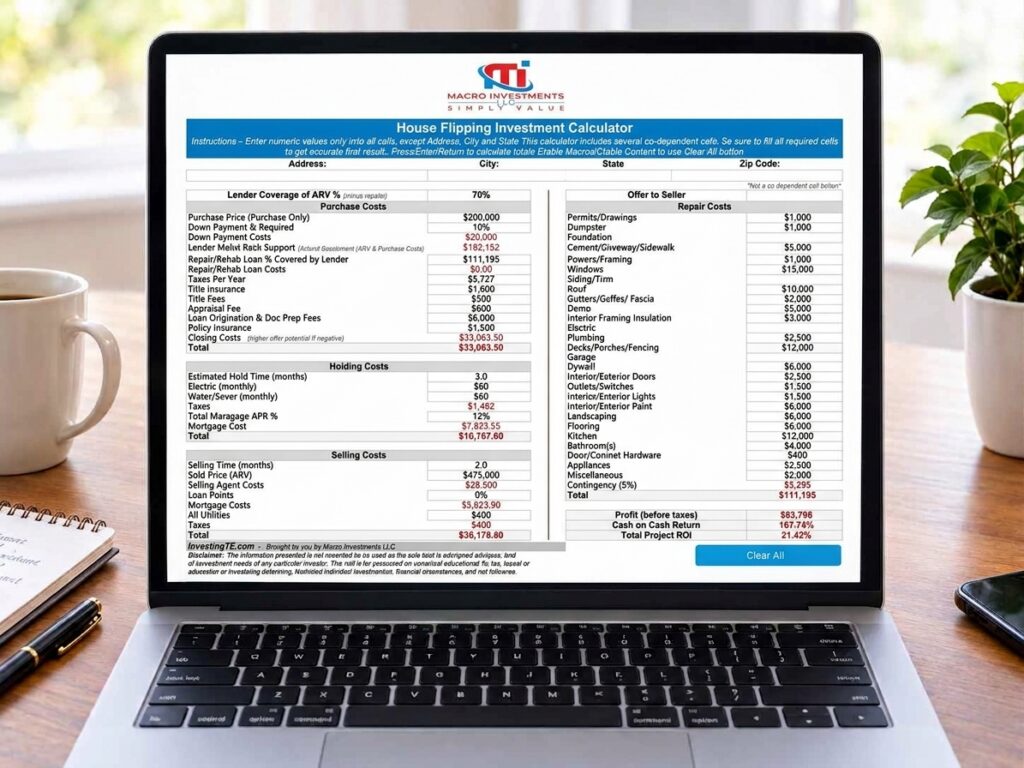
Rather than calculating these figures manually, you can use our House Flipping Investment Calculator to organize acquisition costs, renovation expenses, financing, holding costs, selling expenses, and projected returns in one place.
Step 8: Evaluate the Deal’s Return and Break-Even Point
Projected profit is important, but it should not be the only measure used to evaluate a fix and flip investment.
You should also consider the amount of capital required, the expected time to complete the project, and the potential return relative to the investment.
Return on Investment (ROI)
ROI measures projected profit relative to a defined investment-cost basis.
A simplified calculation is:
ROI = Projected Profit ÷ Defined Investment Cost × 100
For example, if the projected profit is $24,000 and the defined investment-cost basis is $251,000:
$24,000 ÷ $251,000 × 100 = approximately 9.56%
For this calculation, the $251,000 basis includes the modeled project and selling expenses. Other investors or calculators may define ROI differently, so always understand which expenses are included in the denominator.
Cash-on-Cash Return
When financing is involved, cash-on-cash return can provide another perspective.
It compares the projected profit with the actual cash contributed by the investor.
Cash-on-Cash Return = Projected Profit ÷ Investor Cash Invested × 100
The amount of cash invested depends on the down payment, renovation funding, closing expenses, reserves, loan structure, and any additional capital contributions.
Do not substitute total project cost for cash invested when calculating this metric. They are different measures.
Break-Even Sale Price
The break-even sale price is the amount needed to recover the modeled project costs.
If selling costs are a fixed amount, the calculation can be straightforward. However, if selling expenses vary with the sale price, those expenses must be included in the break-even calculation.
Knowing the break-even price helps you understand how much room the project has if the market does not support your original ARV.
If you’re evaluating multiple types of real estate investments, explore our complete collection of real estate investment calculators to help analyze different opportunities and financial scenarios.
The 70% Rule in Fix and Flip Investing
The 70% rule is a commonly used preliminary screening guideline for estimating a potential maximum purchase price.
The simplified formula is:
Maximum Purchase Price = (ARV × 70%) − Estimated Renovation Costs
For example:
- Estimated ARV: $275,000
- 70% of ARV: $192,500
- Estimated renovation costs: $50,000
- Preliminary maximum purchase price: $142,500
Under this guideline, the investor would target a purchase price of approximately $142,500 or less.
However, the 70% rule is not a complete financial analysis. It is a shortcut that uses a generalized margin to account for project expenses and desired profit.
It does not separately calculate every financing charge, acquisition expense, holding cost, selling expense, or other transaction-specific cost.
The appropriate margin will vary by market, property condition, project size, financing structure, risk, and investor return requirements.
Use the rule as an initial screening tool—not as a substitute for a complete fix and flip analysis.
Step 9: Stress-Test the Investment Before Buying
A useful fix and flip analysis should not rely on a single projected outcome.
Before committing capital, evaluate how the project performs under different assumptions.
Consider three scenarios:
Base Case: The property sells near the estimated ARV, renovations stay close to budget, and the project is completed within the expected timeline.
Conservative Case: The resale price is lower than expected, renovation costs increase, and the holding period is extended.
Stress Case: The property experiences a significant cost overrun, a delayed sale, higher financing expenses, and a lower resale price.
For example, consider what happens if:
- ARV is 5% below the original estimate.
- Renovation costs increase by 15%.
- The project takes two additional months.
- Selling expenses increase because of buyer concessions or transaction terms.
These changes can quickly reduce the projected profit.
A deal that only works under the most optimistic assumptions may not provide an acceptable margin of safety.
What Makes a Fix and Flip Analysis Useful?
A complete fix and flip analysis should be:
- Based on realistic and supportable ARV assumptions.
- Supported by relevant comparable sales.
- Built around a detailed renovation scope and budget.
- Inclusive of acquisition, financing, holding, and selling expenses.
- Based on a realistic project and resale timeline.
- Flexible enough to evaluate alternative scenarios.
- Updated as inspections, contractor estimates, financing terms, and market conditions change.
The purpose of the analysis is not to make a property appear profitable.
It is to identify the potential financial outcome, understand the risks, and determine whether the investment meets your requirements before you purchase it.
Fix and Flip Analysis FAQ
What should I include in a fix and flip analysis?
At a minimum, include the purchase price, acquisition expenses, after repair value, renovation costs, contingency, financing, holding expenses, selling costs, and projected profit. You should also evaluate the capital required, project timeline, and potential return.
How do you calculate fix and flip profit?
Estimate the net proceeds from the eventual sale by subtracting selling expenses from the expected resale price. Then subtract the purchase price and all other acquisition, renovation, financing, holding, and project costs. The result is the projected profit.
What is the 70% rule in house flipping?
The 70% rule is a preliminary screening guideline that estimates a maximum purchase price by multiplying ARV by 70% and subtracting estimated renovation costs. It is not a substitute for a complete project budget or investment analysis.
How much should I include for renovation contingency?
The appropriate contingency depends on the property’s age, condition, inspection findings, scope of work, and reliability of contractor estimates. Investors commonly include a reserve for unexpected expenses, but no single percentage is appropriate for every project.
Should financing and holding costs be included in a fix and flip analysis?
Yes. Interest, loan fees, property taxes, insurance, utilities, and other holding expenses can materially affect profitability. Excluding them can make an investment appear more attractive than it actually is.
Can a fix and flip calculator guarantee a profit?
No. A calculator organizes your assumptions and estimates potential financial outcomes. Actual renovation costs, financing expenses, project timelines, market conditions, and resale prices can differ from your projections.
Analyze Your Next Fix and Flip
A thorough fix and flip analysis can help you evaluate a potential investment before committing your money.
InvestingTE’s House Flipping Investment Calculator is designed to help organize acquisition costs, renovation expenses, financing, holding costs, selling expenses, and projected returns in one place.
Use it to evaluate your assumptions, compare potential scenarios, and better understand the financial components of your next house-flipping project.
Get the House Flipping Investment Calculator
Educational disclaimer: This article is for informational and educational purposes only and does not constitute financial, investment, legal, tax, or accounting advice. Investment projections are based on assumptions and are not guarantees of future results. Consult qualified professionals regarding your specific circumstances.
FREE Deal Analysis for Rental Property Calculator!
Our mission is to help others develop using our tools and educational information.
Explore our tools, education and services.